
I remember visiting a client in Hong Kong a few years back—a brilliant stock trader who just couldn’t seem to catch a break. He had the best data, the fastest connection, and a sharp mind, but his office felt like a pressure cooker. When I walked in, the first thing I noticed wasn’t his expensive monitors or the view of the harbor. It was the fact that he was sitting with his back to the door, tucked into a cramped corner with a massive pile of old newspapers to his left. He felt vulnerable, though he didn’t realize it yet. We moved his desk three feet, shifted a few items, and within a month, his “luck” had completely pivoted. That’s the power of knowing how to arrange office desk for success.
It’s not just about aesthetics or being organized. In my years of practicing Feng Shui, I’ve seen that your desk is a microcosm of your career. If it’s chaotic, your professional life likely feels chaotic. If it’s stagnant, your promotions might be stalled. We’re currently in early 2026, and as we move deeper into this year, the energy of our workspaces is more important than ever. Whether you’re in a corporate high-rise or a corner of your bedroom, the way you set up your surface dictates how energy—or Qi—flows toward you.
The Command Position is Everything
If you take only one thing away from our conversation today, let it be this: you must be in the command position. In traditional Feng Shui, this means you should be able to see the door from where you sit, without being directly in line with it. Why? Because historically, you never wanted someone to be able to sneak up on you. In a modern context, it’s about subconscious security. When your back is to the entrance, your nervous system is always slightly “on guard,” which drains your creative energy.
I’ve had people tell me, “Marcus, my cubicle doesn’t allow for that.” I get it. If you can’t move your desk to face the door, place a small mirror on your monitor or desk so you can see the reflection of the entrance behind you. It sounds simple, but the mental relief is immediate. You want to feel like the CEO of your space, even if you’re just starting out.
Mapping Your Desk with the Bagua
Think of your desktop as a map. We use something called the Bagua, which is an energy grid. You can overlay this grid right onto your desk surface. Imagine your desk divided into a nine-part grid (three by three). The side closest to you is the bottom, and the side furthest away is the top.
The Wealth Corner (Top Left)
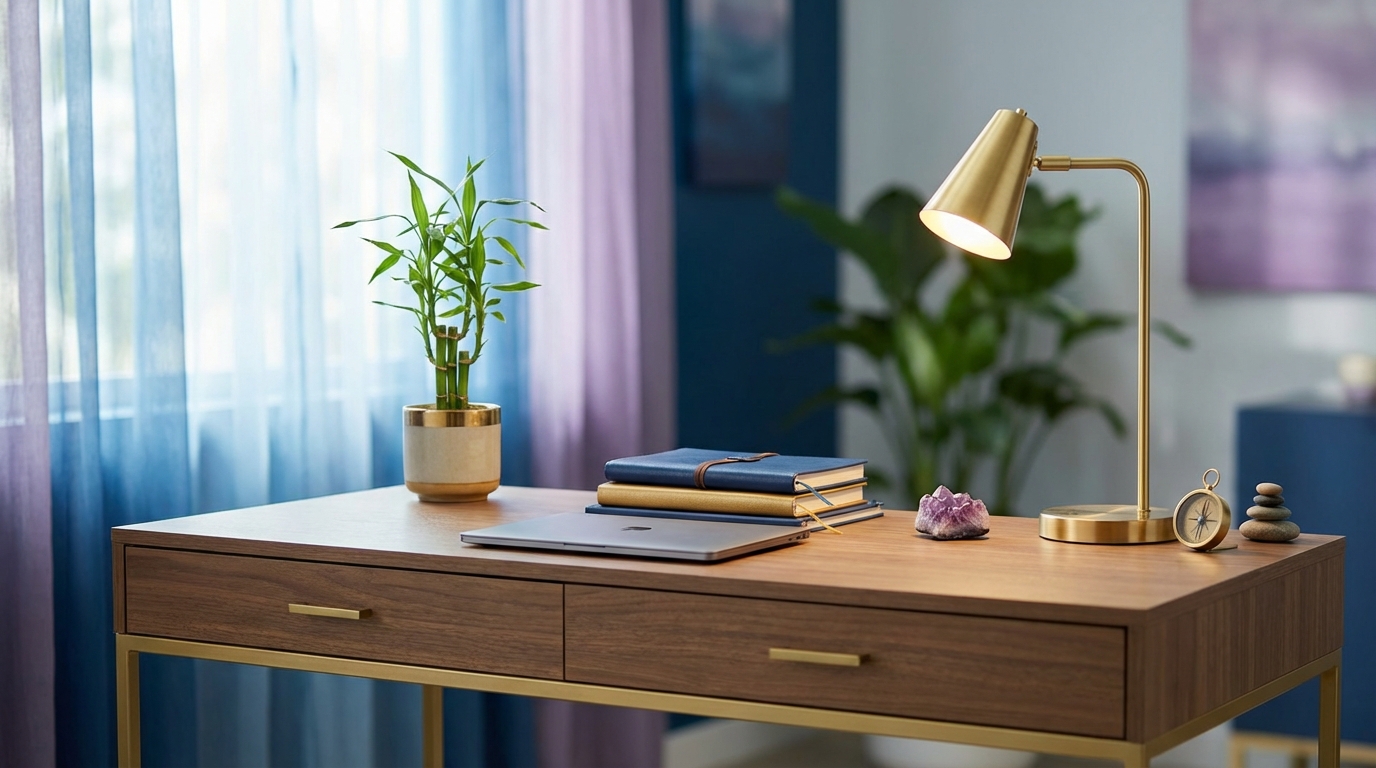
The back-left corner of your desk represents wealth and prosperity. This is a great place for a healthy plant—something with rounded leaves like a money plant—to symbolize growth. I personally keep a small piece of green jade here. Jade has a grounding, prosperous energy that I’ve trusted for years. Just make sure you don’t let dust collect here; dusty wealth is stagnant wealth.
The Fame and Reputation Area (Top Center)
Directly in front of you, at the back of the desk, is the area for fame. This isn’t just about being a celebrity; it’s about how your colleagues and bosses perceive you. This is the perfect spot for your nameplate, a business card holder, or even a lamp. Fire energy rules this area, so a bit of red or a bright light can help “illuminate” your achievements so people actually notice the hard work you’re doing.
The Relationship Corner (Top Right)
The back-right corner is for relationships. If you’re in sales or a role that requires heavy collaboration, pay attention to this spot. I usually suggest keeping things in pairs here—maybe two small crystals or a photo of you and your partner. It keeps the energy of “connection” alive. If this corner is buried under a stack of unpaid bills, don’t be surprised if your professional relationships feel strained.
Balancing the Five Elements
A successful desk needs a balance of the five elements: Wood, Fire, Earth, Metal, and Water. Most modern offices are heavy on Metal (computers, filing cabinets) and Earth (stone or laminate desks), but they often lack Wood and Water.
- Wood: Represents growth and intuition. Use a plant or even just the color green.
- Fire: Represents expansion and passion. Use a red accessory or a desk lamp.
- Earth: Represents stability and grounding. Use a ceramic mug or a stone paperweight.
- Metal: Represents focus and clarity. Your computer and metal trays handle this.
- Water: Represents networking and flow. A small fountain is great, but even a dark blue coaster or an image of a calm ocean works wonders.
I once worked with a creative director who had a very “cold” office—all glass and chrome. He was brilliant but felt totally uninspired. We added a small wooden tray and a warm-toned rug, and he felt his creative spark return almost overnight. It’s all about that balance.
The “Hidden” Clutter Problem
We often talk about the stuff on top of the desk, but what about what’s underneath? I’ve seen desks that look pristine on top, but the drawers are a graveyard of dead pens, old snack wrappers, and manuals for electronics the person doesn’t even own anymore. In Feng Shui, hidden clutter is like a weight tied to your ankles. It represents “unfinished business.”
Take ten minutes this Friday to clear out one drawer. You don’t have to do the whole thing at once. Just get rid of the junk. You’ll find that when the “unseen” space is clear, your mind feels significantly lighter. I always tell my students: your outer environment reflects your inner state. If your drawers are a mess, your thoughts probably are too.
What You See Matters
When you look up from your computer, what do you see? If you’re staring at a blank, grey wall, your career might feel like it’s hitting a wall. If possible, place a piece of art that depicts a far-off horizon or a mountain range. Mountains represent support and stability—placing an image of a mountain behind your chair is actually a classic “protection” move in Feng Shui. It’s like having a “mountain at your back” to support you.
If you’re facing a window, that’s beautiful, but be careful. If the view is too distracting, you’re literally watching your energy fly out the window. I usually suggest placing a small plant on the windowsill to “catch” the energy and keep it in the room with you.
A Few Practical Habits for Daily Success
Arranging the desk is the first step, but maintaining the energy is a daily practice. Here is how I handle my own workspace every evening before I leave:
- Clear the Surface: I don’t leave a single piece of paper out unless it’s the very first thing I need to work on tomorrow.
- The Water Ritual: I empty my water glass. Stagnant water overnight creates stagnant energy.
- Closing the Loop: I write down the “Top 3” things I need to accomplish the next day. This moves the mental load from my head onto the paper, allowing me to actually enjoy my evening.
You might think these are just productivity tips, but they are deeply rooted in the idea of Sheng Qi—uplifting, vital energy. When you walk into your office the next morning and see a clean, well-ordered desk, you’re greeted by a fresh start rather than yesterday’s problems.
It’s easy to get overwhelmed by all the “rules,” but start small. Move your desk into the command position or clear out that one junk drawer. Feng Shui is a journey, not a destination. As you shift your physical space, you’ll notice your internal perspective shifting too. So, tell me—what’s the first thing you’re going to change on your desk today?