
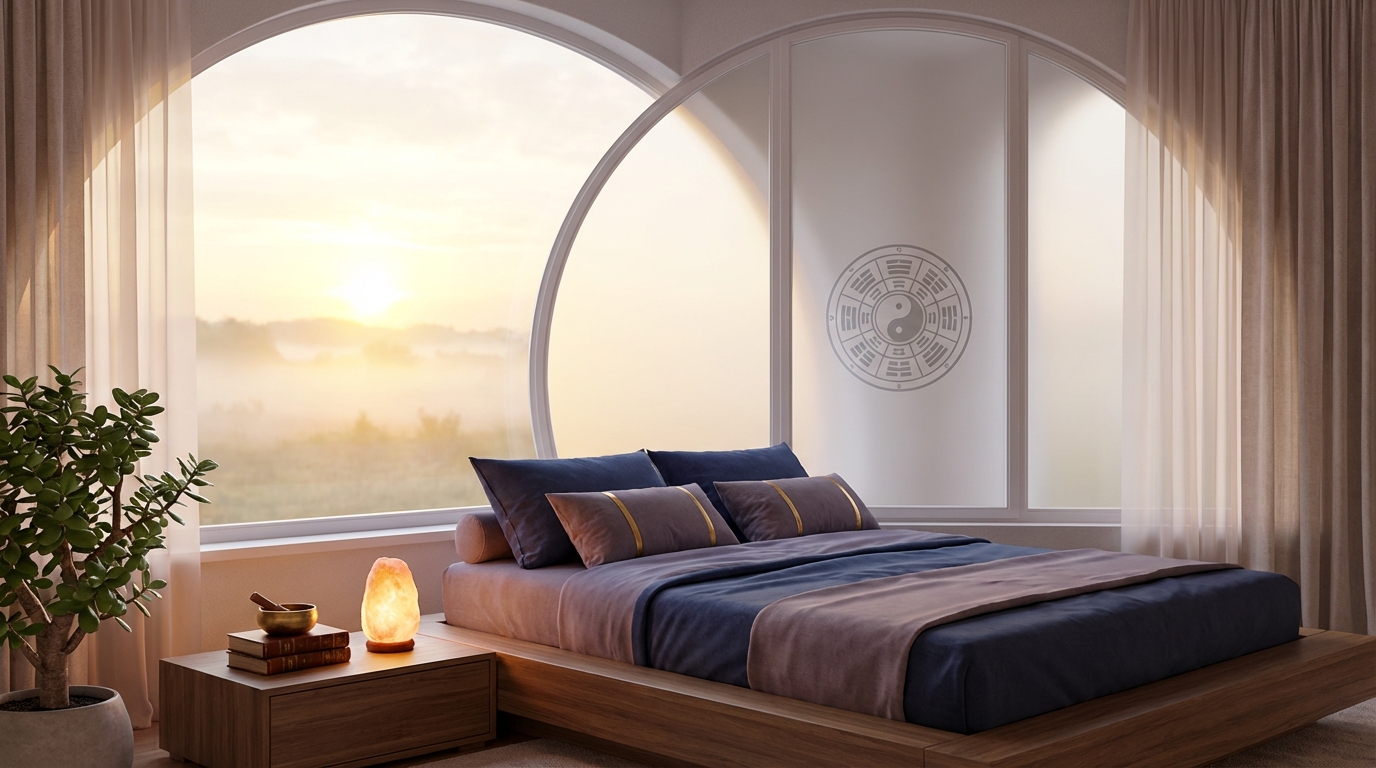
I was visiting a client last week in a beautiful high-rise. It’s early 2026, and everyone seems to be obsessed with floor-to-ceiling glass and “bringing the outside in.” My client had this stunning view of the skyline, but she had a problem she couldn’t quite pin down. She was exhausted. Despite her luxury mattress and high-end linens, she felt restless every single night. I took one look at her bedroom and saw the culprit immediately: her bed was pushed right up against a massive window.
In the world of Feng Shui, this is one of those classic dilemmas. We want the light, we want the view, but our subconscious minds are screaming for security. If you’ve been waking up feeling like you haven’t slept at all, or if you feel a strange sense of vulnerability when you turn the lights out, we need to talk about your bed placement. It’s not just about “bad luck”—it’s about how energy moves through your room and how your body reacts to it.
Why the Window is a Problem
In traditional Chinese metaphysics, we talk a lot about the concept of the “Mountain.” Ideally, when you sleep, you want a solid “mountain” behind your head. This represents support, stability, and protection. In a modern home, that mountain is usually a solid wall. When you replace that solid wall with a window, you’re essentially trying to lean against a cloud. It just doesn’t work.
Think about it from a purely primal perspective. Our ancestors didn’t sleep in the open with their heads exposed to the elements or potential predators. We are hardwired to want a solid barrier behind us. When there’s a window behind your head, your nervous system stays on high alert. You might not realize it, but your brain is tracking every rustle of a leaf, every change in light, and every draft. This keeps you in a lighter stage of sleep, preventing that deep, restorative rest we all desperately need.
Then there’s the flow of Qi—the life force energy. Windows are transition points where energy enters and exits. When your bed is directly under a window, the Qi flows right over you like a rushing river. Instead of the energy gently pooling and nourishing you while you sleep, it’s pulling at your own personal energy. It’s no wonder people in this situation often wake up feeling “leaked” or drained.
The Practical Side of the Issue
Beyond the metaphysical, there are some very real, practical reasons why feng shui bed placement window issues are so common. I’ve noticed that even people who don’t believe in energy work eventually come to the same conclusions once they experience the physical discomfort.
- Temperature fluctuations: Even with the best double-paned glass we have in 2026, windows are still the weakest point of insulation in a room. You’ll feel the chill in the winter and the heat in the summer right at your crown chakra.
- Light pollution: Streetlights, moonlight, or the early morning sun can disrupt your circadian rhythm. Even if you use an eye mask, your skin and your brain still register the light.
- Noise: Glass doesn’t block sound as well as a brick or drywall. Every car that passes or neighbor who talks outside becomes part of your dreamscape.
I remember a student of mine back in Hong Kong who insisted that his “view of the harbor” was worth the lack of a headwall. Three months later, he admitted he was drinking four espressos a day just to function. We moved his bed three feet to the left against a solid wall, and his caffeine habit vanished within a week. The difference is that dramatic.
What if You Have No Other Choice?
Now, I know what you’re thinking. “Marcus, my room is the size of a shoebox. The only place the bed fits is under the window!” I get it. I’ve lived in those apartments. Sometimes the architecture of the room forces our hand. If you absolutely cannot move your bed to a solid wall, you aren’t doomed to a lifetime of bad sleep. We just have to get creative with our “cures.”
The Power of a Solid Headboard
If you must sleep under a window, your headboard becomes your most important piece of furniture. You need something heavy, solid, and tall. Avoid those trendy slatted headboards or metal bars where you can see through to the other side. You want a solid piece of wood or a thick, upholstered headboard. This acts as a “buffer” or a man-made mountain between your head and the window. It creates a sense of enclosure that helps trick the brain into feeling safe.
Heavy Drapery is Your Friend
Forget those flimsy, sheer curtains. If your bed is under a window, you need heavy, “blackout” style drapes. During the day, you can open them up and let the light in. But at night, you want to create the illusion of a solid wall. Closing thick curtains creates a layer of “dead air” that helps with insulation and sound, but more importantly, it visually closes off the “hole” in the wall. It keeps the Qi from escaping so quickly.
Leave a Gap
If space allows, try not to push the bed flush against the window. Even a gap of six to twelve inches can make a difference. It allows the energy to circulate a bit more freely without hitting you directly. It also prevents you from feeling the direct “chill” of the glass during those cold January nights.
The “Command Position” Factor
While we’re talking about windows, we have to talk about where the bed sits in relation to the door. This is what we call the “Command Position.” Ideally, you want to see the door from your bed without being directly in line with it. If putting your bed under the window is the only way to see the door, it might actually be the lesser of two evils.
I once worked with a guy who moved his bed away from the window but ended up in the “coffin position”—where his feet pointed directly out the door. He started having nightmares immediately. In Feng Shui, it’s always a balancing act. If you have to choose between a window behind you or your feet pointing out the door, I’d usually tell you to take the window and fix it with a solid headboard and heavy curtains. It’s all about choosing the path of least resistance for the energy.
How to Test Your Setup
You don’t need a Luopan (a Feng Shui compass) to tell if your bed placement is working. Your body is the best tool you have. I tell my clients to do a “three-night check.” After you make a change—like adding a new headboard or moving the bed—give it three nights.
Ask yourself these questions:
- Do I feel “safe” when I first lie down?
- Am I waking up at 3:00 AM for no reason?
- Is my first thought in the morning “I’m tired” or “I’m ready”?
If you’re still feeling uneasy, something is off. Sometimes, it’s not just the window. It could be a mirror reflecting the bed, or clutter shoved underneath it. But nine times out of ten, if the head of the bed isn’t secure, the rest of the room’s energy will feel “flighty.”
Final Thoughts on Modern Living
We live in a world that is increasingly transparent. We share our lives on social media, we live in glass buildings, and we’re always “on.” Our bedrooms need to be the opposite of that. They should be our caves—dark, quiet, and secure. Even if you love the aesthetic of a bed framed by a beautiful window, consider the toll it takes on your subconscious.
I always tell people that Feng Shui isn’t about following rigid rules from a book written hundreds of years ago. It’s about understanding how humans interact with their environment. We are biological creatures. We need to feel supported. If you can move that bed to a solid wall today, do it. You’ll be surprised at how much “luck” suddenly finds you when you’re actually well-rested enough to grab it.
Have you tried moving your bed recently? Or are you stuck with a window you can’t avoid? Sometimes just a small shift in perspective—and a set of heavy curtains—is all it takes to change the entire vibe of your home.