
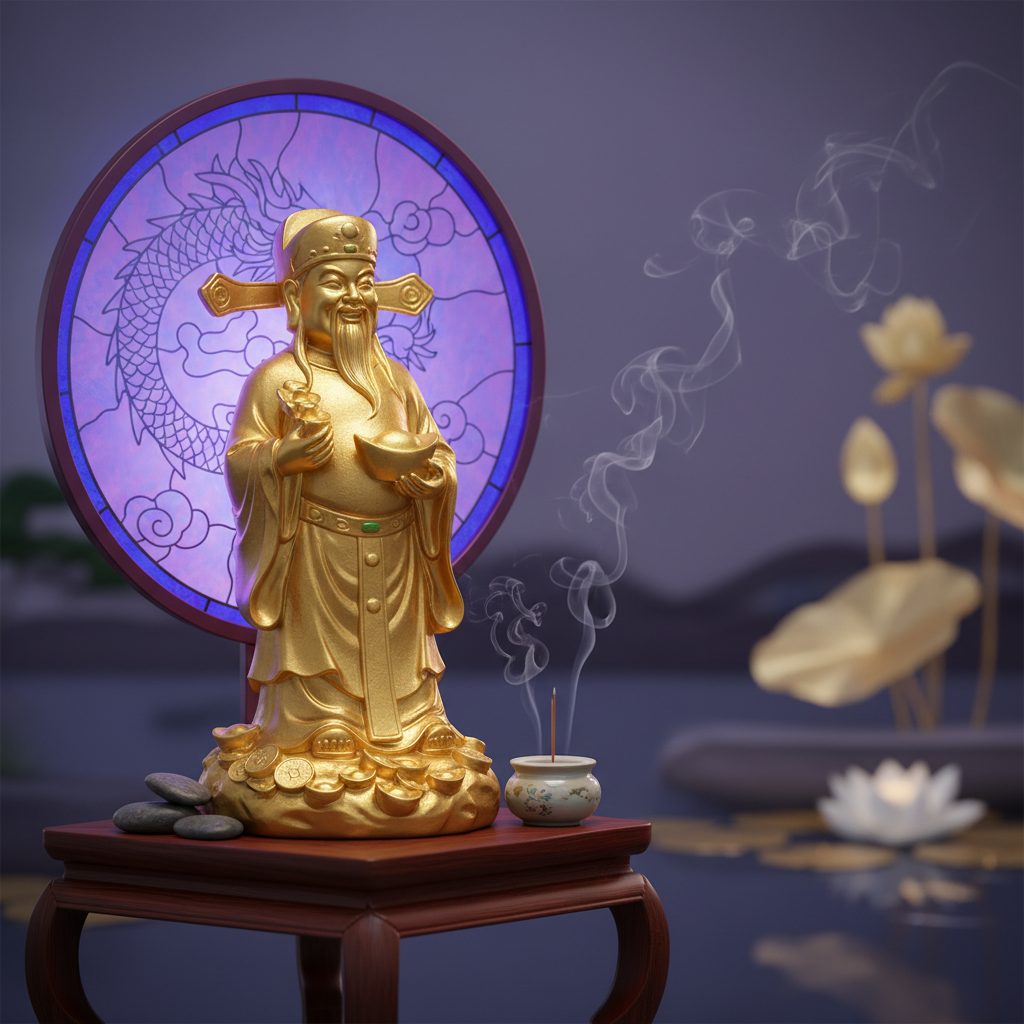
I remember the first time I walked into my uncle’s office and saw this striking, bearded figure sitting prominently on a high shelf. He looked regal, dressed in flowing robes, holding a massive gold ingot, and surrounded by bright red decorations. I asked, “Who’s the guy in the fancy hat?” My uncle laughed and told me that was his most important “business partner.” That was my very first introduction to the concept of a deity dedicated entirely to prosperity.
If you’ve ever stepped into a traditional Chinese shop, a family-run restaurant, or even a modern corporate office in Asia, you’ve probably asked yourself the same thing: who is the god of wealth? It’s a question that leads down a fascinating rabbit hole of history, folklore, and practical Feng Shui. It turns out, there isn’t just one “guy”—there’s actually a whole pantheon of figures that people look to when they want to boost their financial luck.
But why does it matter? Well, in the world of Feng Shui and wealth manifestation, these figures aren’t just decorations. They represent a specific energy or “vibe” that we want to invite into our spaces. Whether you’re a believer or just someone who appreciates the symbolism, understanding these figures can change how you look at your own relationship with money.
Meeting Caishen: The Most Famous Face
When most people ask who is the god of wealth, they are usually referring to Caishen (or Tsai Shen Yeh). He’s the most widely recognized figure in Chinese culture. You’ll see him everywhere during the Lunar New Year—on red envelopes, posters, and even as people dressed in costumes handing out candy in shopping malls.
Caishen is often depicted as a dignified official wearing a minister’s hat and carrying a “ruyi” (a ceremonial scepter) or a large gold ingot. But here’s the interesting part: Caishen isn’t just one historical person. Depending on who you talk to, Caishen can manifest in different forms. I’ve found that most practitioners categorize him into two main types: the Military God of Wealth and the Civil God of Wealth. Choosing between them usually depends on how you make your living.
The Military God of Wealth (Zhao Gongming)
If you’re someone who takes big risks, works in a highly competitive industry, or perhaps runs a business where you have to “fight” for your market share, you’d likely be looking at Zhao Gongming. He’s the “Military” version of Caishen.
I’ve always found his imagery particularly cool. He’s usually shown riding a black tiger and holding a silver rod or a bowl of treasures. He looks fierce—and that’s the point. He’s there to protect your wealth and help you aggressively pursue new opportunities. He’s not about passive income; he’s about the hustle. If you’ve ever felt like you’re in a “battle” to get your business off the ground, this is the energy you’re tapping into.
The Civil God of Wealth (Bi Gan)
On the flip side, we have the “Civil” God of Wealth, often identified as Bi Gan. This figure is much more peaceful. He’s the patron for office workers, professionals, and those who earn their money through steady, honest work and wisdom rather than “combat.”
Legend says Bi Gan was a wise minister who was incredibly loyal. In many depictions, he’s shown with a calm expression, holding a scroll or an ingot. I often tell my friends who work in corporate jobs or creative fields that this is the figure that resonates most with their path. It’s about the slow and steady accumulation of wealth through intelligence and integrity.
Wait, Isn’t the Laughing Buddha the God of Wealth?
This is a common mix-up I see all the time. You’ve probably seen the “Laughing Buddha”—that jolly, pot-bellied figure with a huge grin. While he is a symbol of happiness and abundance, he isn’t technically the God of Wealth in the traditional sense. His name is Budai, and he represents contentment and the “wealth” of a happy life.
However, because he’s often shown carrying a sack (supposedly full of treasures or food) and surrounded by coins, he has become a “de facto” wealth deity for many. I actually have a small one on my desk. Why? Because he reminds me that wealth without joy is pretty pointless. If you’re looking for who is the god of wealth specifically for financial transactions, stick with Caishen. But if you want the “vibe” of overall abundance, Budai is your guy.
Guan Yu: The God of Integrity and Business
Another heavy hitter you’ll see in many business settings is Guan Yu (also known as Guan Gong). You can recognize him by his red face and long, flowing beard. He’s technically a God of War, but in the business world, he’s revered as a God of Wealth. Now, why would a general be a wealth deity?
It comes down to integrity. In traditional Chinese business culture, your word is your bond. Guan Yu represents extreme loyalty and honesty. Merchants started worshipping him because they wanted to show their customers (and partners) that they were honorable.
I once visited a high-end jewelry shop in Hong Kong, and right there in the back office was a large statue of Guan Yu. The owner told me that having him there wasn’t just about bringing in money; it was about ensuring that every deal made in that room was fair. I love that idea—that wealth should be built on a foundation of trust. If you’re wondering who is the god of wealth that oversees contracts and partnerships, it’s definitely Guan Yu.
The Five Road Wealth Gods
If you really want to get technical, there’s a group known as the “Five Road Wealth Gods.” The idea here is that wealth can come at you from any direction—North, South, East, West, and Center.
- The Center: Usually Zhao Gongming (the military guy we talked about).
- The East: Xiao Sheng, the God of Collecting Treasures.
- The West: Cao Bao, the God of Collecting Valuables.
- The North: Yao Shaosi, the God of Profitable Trade.
- The South: Chen Jiugong, the God of Attracting Wealth.
When people perform rituals to “welcome the God of Wealth” during the New Year, they are often symbolically opening their doors to all five directions. It’s a way of saying, “I’m ready for opportunity, no matter where it comes from.” I think there’s a great psychological lesson there—being open-minded enough to spot opportunities in places you weren’t originally looking.
How People Actually Interact With These Figures
You might be wondering, “Okay, so people have these statues, but what do they actually do with them?” It’s not just about letting them collect dust. In Feng Shui, the placement and care of these figures are everything.
I’ve noticed a few common practices that people use to keep the “wealth energy” fresh:
- Placement: You almost never see a wealth god sitting on the floor. They are usually placed on a high shelf, facing the main entrance. The idea is that they “greet” the wealth as it enters your home or office.
- Cleanliness: A dusty God of Wealth is a big no-no. It’s seen as a sign of neglecting your finances. Keeping the area clean is a physical manifestation of looking after your money.
- Offerings: You’ll often see oranges, tea, or incense placed in front of them. It’s a gesture of respect. While I don’t do full-blown rituals every day, I do find that keeping my “wealth corner” tidy helps me stay focused on my financial goals.
- The “Facing” Rule: Generally, you don’t want the God of Wealth facing a window or a bathroom. You want that energy staying inside the room, not “leaking” out.
The Symbolism Behind the Myth
At the end of the day, whether you view these figures as actual deities or just cultural symbols, there’s a lot of wisdom in the stories. When we ask who is the god of wealth, we’re really asking: what qualities do I need to cultivate to be prosperous?
If you look at Zhao Gongming, the answer is courage and action. If you look at Bi Gan, it’s wisdom and loyalty. If you look at Guan Yu, it’s integrity. And if you look at the Laughing Buddha, it’s joy and generosity.
I’ve found that the most successful people I know actually embody a bit of all of them. They are brave enough to take risks, smart enough to plan, honest enough to build a reputation, and happy enough to enjoy what they’ve earned.
So, the next time you see one of those golden statues in a restaurant or a shop, you’ll know exactly who you’re looking at. They aren’t just “lucky charms”—they are reminders of the different paths to abundance. Do you feel more like a “Military” wealth seeker today, or are you leaning into that “Civil” wisdom? Sometimes, just asking yourself that can help shift your mindset for the day.
Have you ever felt a particular connection to one of these figures, or maybe you’ve got a favorite “wealth magnet” in your own home? I’d love to hear about what helps you stay in that abundance mindset.