You have a red string in your hand and one question: which wrist does it go on? Search around and you will find people who swear by the left, people who insist on the right, and a few who say it does not matter at all. They are all repeating something real, because the red string is not one tradition. It is several traditions that happen to share a color.
The quick answer: left wrist, unless your tradition says otherwise
If you want one rule to follow, use the left wrist. It is the convention most often quoted for red string bracelets in feng shui circles and in Kabbalah-inspired practice, and it is the one most jewelers and shops will tell you. The reasoning is that the left side is the “receiving” side of the body, so a string worn there is meant to take in protection and good luck rather than send it out.
That said, the honest version is: there is no single official rule. Hindu, Buddhist and Chinese customs each have their own habits, and some of them point to the right wrist. Below is what each one actually says, so you can choose with your eyes open.
Which wrist in each tradition
| Tradition | Commonly worn on | Reason usually given |
|---|---|---|
| Kabbalah-inspired (Jewish folk custom) | Left wrist | Left is the receiving side; the thread is worn to ward off the evil eye |
| Feng shui (modern practice) | Left wrist | Draw luck and protection in; red is the color of vitality and good fortune |
| Hindu (mauli or kalava thread) | Right wrist for men and unmarried women, left for married women | Tied during a puja as a blessing; the side depends on custom and family |
| Tibetan Buddhist protection cords | Wrist or neck, no fixed side | A cord given after a blessing; what matters is that it was blessed, not the side |
| Chinese “red thread of fate” | No fixed side | A legend about destined connection, not a wearing rule |
Look at the last two rows. In Tibetan Buddhism and in the Chinese legend, the wrist is not really the point. In the Kabbalah-inspired and feng shui versions, the left wrist is the point. Hindu custom is the one that actually changes the answer depending on who you are.
A closer look at the Chinese meaning
In Chinese culture, red is the color of luck, celebration and protection, so a red cord fits naturally into everyday life. The older story behind the “red thread of fate” comes from a Tang dynasty tale in which an old matchmaker ties a red cord between two people destined to meet. In the Chinese telling the cord binds the couple’s feet, while Japanese versions moved it to the little finger. Neither version is about a bracelet, but they explain why a red string became a symbol for connection and being looked after.
There is also a very practical custom: in your benming nian, the year of your own zodiac animal, many Chinese families give red items as protection, because that year is traditionally seen as a difficult one. 2026 is a Horse year, so anyone born in a Horse year (1990 and 2002, for example) is in theirs. If that is you, a red string is a very traditional thing to be wearing. Our guide to choosing a feng shui bracelet for your zodiac sign goes deeper on this.
How to put on a red string bracelet
Whichever wrist you choose, the routine is simple:
- Decide what you want it to mean. Protection, a fresh start, staying connected to someone. A clear intention is the part every tradition agrees on.
- Choose your wrist. Left if you have no tradition of your own to follow.
- Get a comfortable fit. It should sit close to the wrist without pinching. A sliding knot lets you adjust it without untying anything.
- Consider having someone else tie it. In several traditions, the person who ties it matters. A popular Kabbalah-inspired custom is to have a loved one tie seven knots.
- Wear it, then leave it alone. Do not keep checking it. It is a quiet reminder, not a switch you have to keep pressing.
Can’t decide? Three tie-breakers
- Your watch or your main bracelet. Put the string on the opposite wrist so nothing rubs or tangles.
- Your dominant hand. A cord on the non-dominant wrist gets less wear and lasts longer, and for most right-handed people that is the left wrist anyway.
- What you do all day. If you type, lift or cook, choose the side that catches on things least.
If you have been told a different side by a family member or a teacher, follow them. That advice comes from a real tradition and is worth more than any general rule.
Red string bracelets we carry
If you are looking for a piece to start with, these are the ones customers most often ask about. All of them use an adjustable sliding knot.
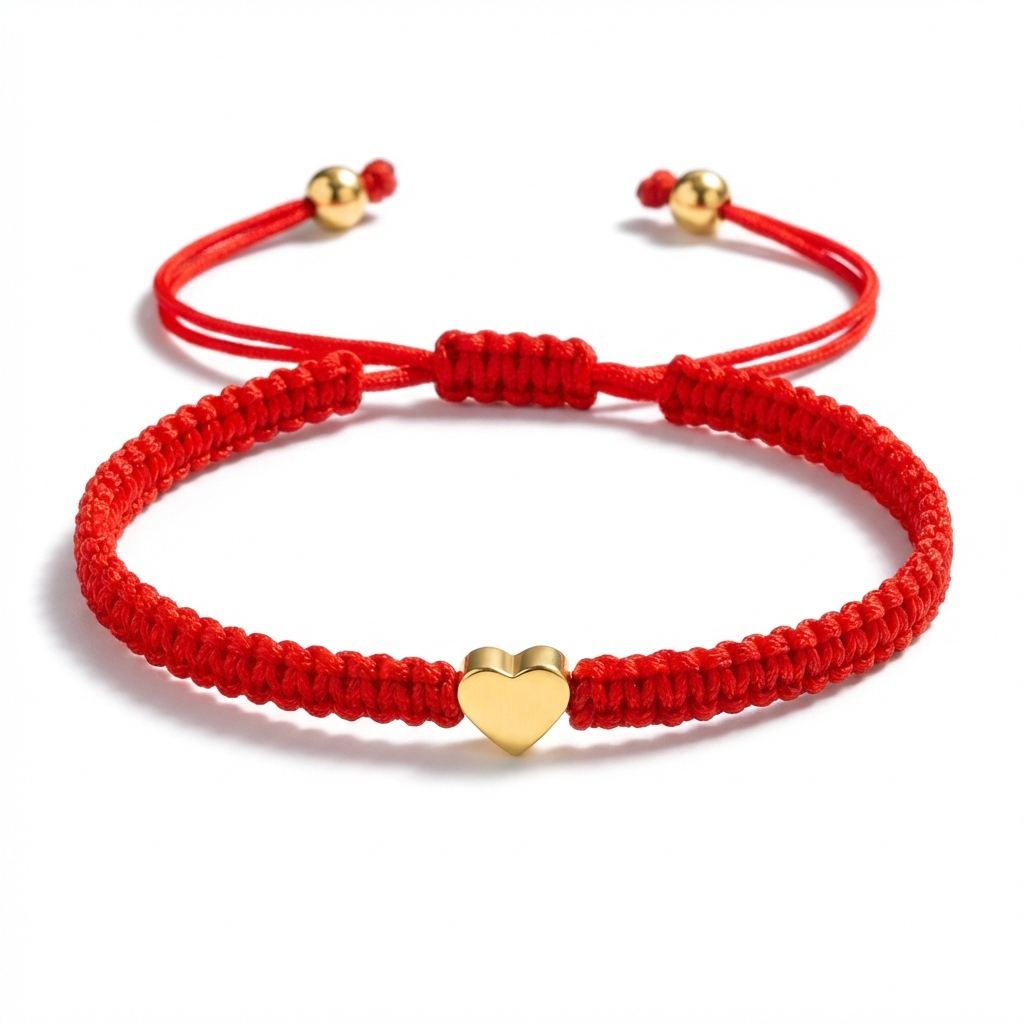
The Red String Heart Bracelet pairs a hand-braided red cord with a small alloy heart. It is inspired by the red thread of fate, so it suits anyone who thinks of the string as a symbol of connection.
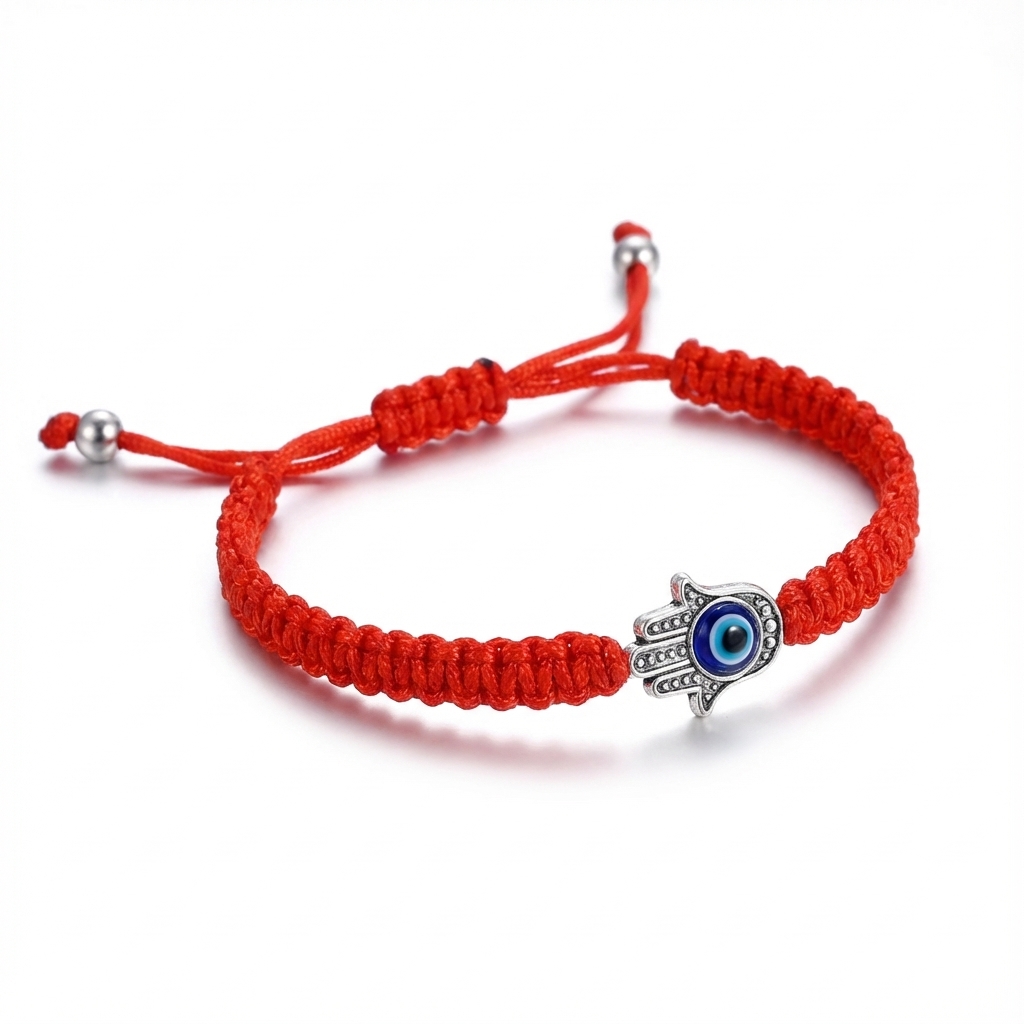
The Hamsa Hand Red String Bracelet adds a metal Hamsa Hand charm to the braided red cord, combining two protective symbols. If you want to know how the two differ, read our comparison of the hamsa hand and the evil eye. For something in the Tibetan tradition, the Tibetan Red String Bracelet has a red cord with an engraved mantra charm in sterling silver or gold-plated finish, and our guide to the Om Mani Padme Hum mantra explains what that inscription says.
When a red string breaks or fades
A cotton cord does not last forever, especially if you wear it in the shower. Many people treat a string that snaps as a sign that it has “done its work”, and simply replace it. Practically, water and daily friction are what wear cords out, so taking it off for swimming and showers will keep it going longer. To go deeper on why people wear red strings in the first place, see why everyone seems to be wearing a red string bracelet lately.
Frequently asked questions
Can men wear a red string on either wrist?
Yes. In the feng shui and Kabbalah-inspired convention, the left wrist is suggested for everyone. Hindu custom is the one place where the side changes with gender and marital status.
Can I wear a red string on my ankle instead?
Many people do, especially in warm weather or if they work with their hands. In the older Chinese legend the red cord ties two people’s feet, so an ankle string has real precedent.
Do I have to wear it all the time?
No tradition requires it. Wear it when you want the reminder, and take it off for anything that would damage it.
Can I wear it with other bracelets?
Yes. A red string looks good stacked with a stone bracelet, and there is no rule against it. If you want a pairing that fits the same theme, see our guide to how to wear a feng shui wealth bracelet.
A note: the meanings above come from cultural and spiritual traditions. A red string is a symbol and a personal reminder, not a guarantee of any outcome.
[social_share]