Six syllables, repeated millions of times a day by Tibetan Buddhists: Om Mani Padme Hum. You have probably seen it carved on stones along mountain paths, printed on prayer flags, or engraved on a bracelet. Before you wear it, it helps to know what it actually says, because it is not a slogan or a lucky charm. It is one of the most important mantras in Buddhism.
What does Om Mani Padme Hum mean?
It is the mantra of Avalokiteshvara, known in Tibetan as Chenrezig, the bodhisattva of compassion. The Dalai Lama is traditionally regarded as his living embodiment, so for Tibetans the mantra is a direct invitation to compassion.
The most common English rendering is “the jewel in the lotus”, but that is only a rough translation, and Buddhist teachers explain that the six syllables carry a much larger meaning than any single phrase can hold. Sanskrit scholars and practitioners have offered several readings over the centuries, and there is no one official translation.
The mantra, syllable by syllable
One popular teaching links the six syllables to the six perfections that a practitioner cultivates:
| Syllable | Commonly linked to |
|---|---|
| Om | Generosity |
| Ma | Ethics |
| Ni | Patience |
| Pad | Perseverance |
| Me | Concentration |
| Hum | Wisdom |
In Tibetan the mantra is usually pronounced closer to Om Mani Peme Hung, which is worth knowing if you ever hear it chanted.
Why is it on bracelets?
Tibetan Buddhists keep the mantra close in many forms: on prayer wheels, on flags, on mani stones and on malas (prayer beads). A bracelet is a small, portable version of the same idea, a physical reminder to bring compassion to what you do that day. Many people wear it for that reason alone.
Is it okay to wear it if you are not Buddhist?
Many non-Buddhists wear it, and it is generally seen as respectful when done thoughtfully. A few habits are worth adopting:
- Treat it as a sacred text, not a decoration. Many practitioners avoid letting written mantras touch the floor.
- Take it off in places that would feel disrespectful, such as the bathroom, if that matches your own sense of respect.
- Understand it is a reminder, not a blessing. A traditional protection object is blessed by a teacher. A bracelet bought online is a reminder you carry, not a blessed item.
Which hand should you wear it on?
There is no rule in Tibetan Buddhism about the wrist. People wear it on whichever side is comfortable. If you follow the common feng shui and folk convention of wearing protective jewelry on the left, our guide to which wrist to wear a red string bracelet explains the reasoning.
Om Mani Padme Hum bracelets we carry
These pieces come in several materials, so you can choose the finish you like.
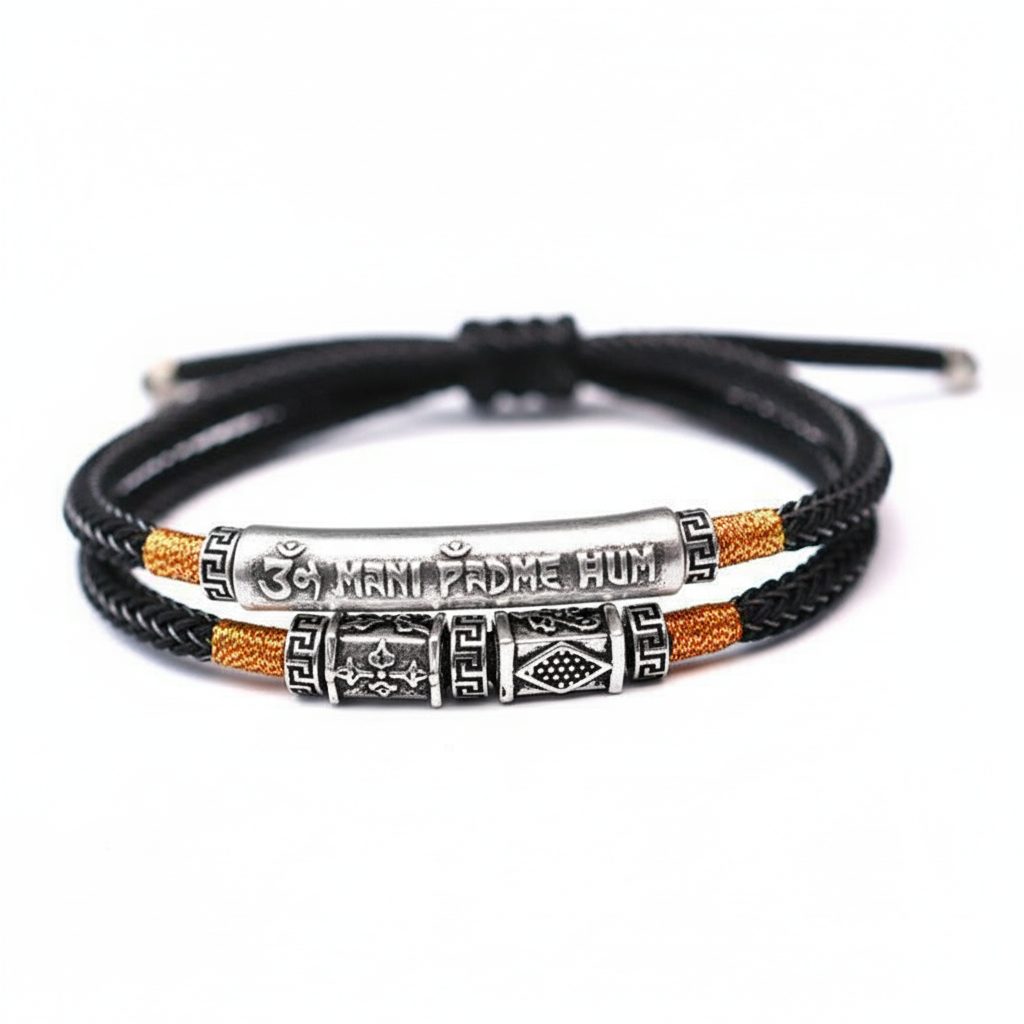
The Sterling Silver Tibetan Mantra Bracelet is a 2-in-1 design combining traditional Tibetan rope with sterling silver, with the mantra on it, a vintage-style finish and adjustable sliding knots.
The Tibetan 925 Silver Mantra Bracelet features a 925 sterling silver cylinder engraved with the mantra on an adjustable dragon knot cord.
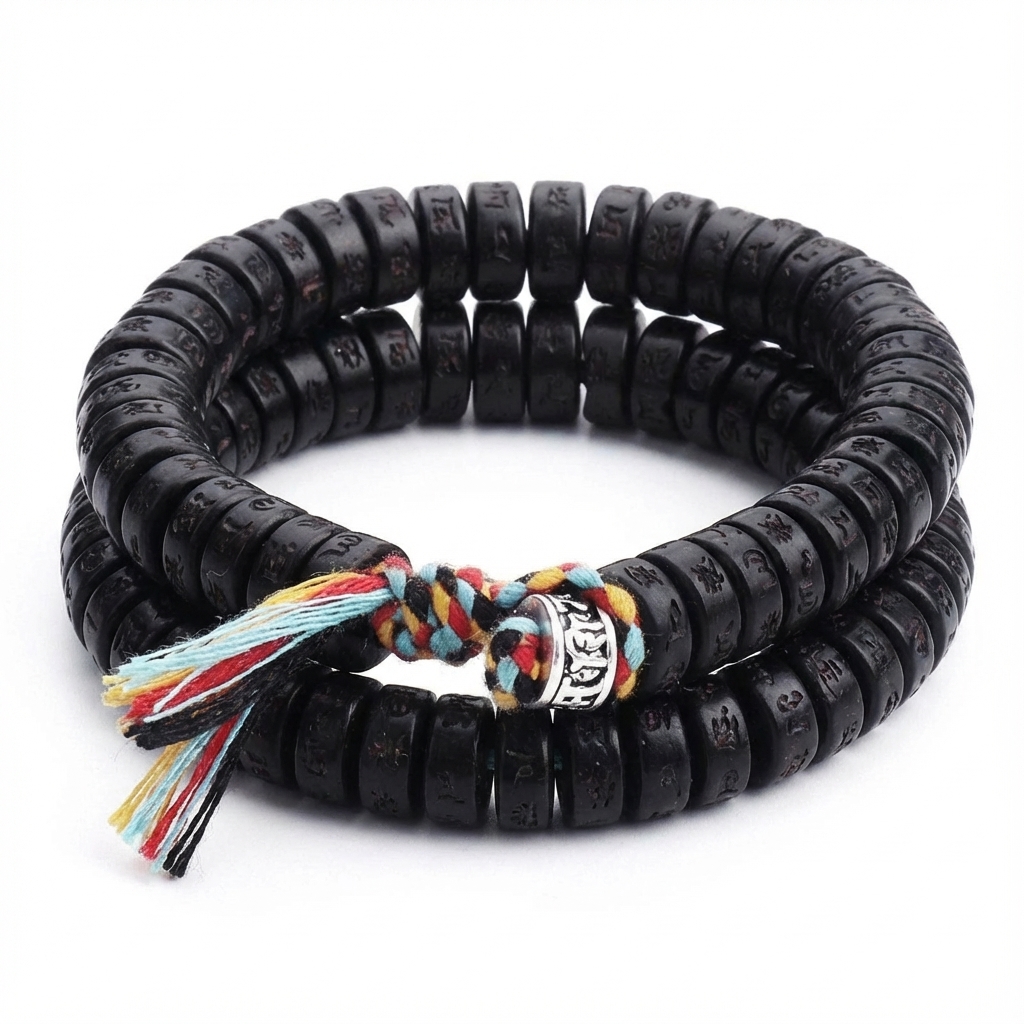
The Coconut Shell Mantra Bracelet uses genuine coconut shell beads engraved with the mantra, hand-braided with cotton thread and accented with a white copper ring. It has a natural, earthy feel.
The Copper Wu Lou Mantra Bracelet uses 12mm copper alloy beads engraved with the mantra and the lotus symbol, centered on a Wu Lou charm, and our guide to the Wu Lou bracelet explains that symbol. For the knot pattern often braided into these cords, see what the Tibetan knot bracelet means.
A simple way to use the mantra
- Sit quietly for a minute when you put the bracelet on.
- Say the six syllables slowly, aloud or in your head, once or a few times.
- Bring to mind one person or situation where you would like to act with more patience or kindness.
- Whenever you notice the bracelet during the day, take one breath and remember.
That is all. It costs nothing, takes a minute, and keeps the bracelet doing what it was designed to do.
Where else you will see the mantra
- Mani stones and walls. Stones carved with the six syllables are stacked along paths and at the edges of villages across the Himalayan region. Walkers traditionally keep the wall on their right and pass clockwise.
- Prayer wheels. Each turn of a wheel is regarded as equal to reciting the mantras written inside it.
- Prayer flags. Flags printed with mantras and prayers are strung on high passes so the wind carries the words.
- Malas. Strings of prayer beads used to count repetitions.
The lotus and the jewel
The imagery in the words is worth a moment. In Buddhist art the lotus grows out of muddy water and opens clean, which is why it stands for purity and awakening rising from difficulty. The jewel is a common symbol for the mind’s precious potential. Read together, many people take the phrase as a reminder that compassion and wisdom can bloom from ordinary, messy circumstances.
Frequently asked questions
Is it a prayer for luck or wealth?
Not traditionally. The mantra is about compassion and the path to wisdom. Wearing it “for luck” is common in popular use, but it is not the mantra’s original purpose.
What is a mala?
A mala is a string of prayer beads, usually 108 beads, used to count repetitions of a mantra. A bracelet is not a full mala, but it draws on the same tradition. For a wider look at spiritual jewelry, read our feng shui crystal bracelet guide.
Do I need to know Tibetan to say it?
No. Say it as best you can, with sincerity. The intention matters more than the pronunciation.
A note: this mantra is sacred in Tibetan Buddhism, and interpretations differ between teachers and lineages. This article is a general introduction, not religious instruction.
[social_share]