A Tibetan knot bracelet looks simple: a braided cord, a sliding knot, and a small woven pattern on top. But the pattern is the point. That little woven shape is usually the endless knot, one of the oldest symbols in Tibetan Buddhism, and it has a lot more to say than most people expect.
What is the Tibetan endless knot?
The endless knot (in Tibetan, dpal be’u; in Sanskrit, shrivatsa) is a closed, interlaced design with no beginning and no end. It is one of the Eight Auspicious Symbols of Tibetan Buddhism, alongside the parasol, the golden fish, the treasure vase, the lotus, the conch shell, the victory banner and the wheel.
Because the line loops back on itself, the knot is read as a picture of things that cannot be separated. Common interpretations include:
- Interdependence: everything is connected to everything else.
- Wisdom and compassion: two qualities woven together and inseparable.
- The cycle of time and life: no fixed start or finish.
Chinese decorative knotting has a closely related design called the pán cháng knot, which stands for a long life and unbroken good fortune. That is why you will find the same pattern described as both “Tibetan” and “Chinese lucky knot”.
What does a Tibetan knot bracelet mean?
Worn as jewelry, the bracelet carries the endless knot’s meanings into daily life. For most people it is one of three things:
- A reminder of connection. A quiet nudge that your choices and relationships are linked.
- A symbol of steadiness. The unbroken loop is read as continuity and resilience.
- A good-luck charm. In popular use, the knot is simply seen as auspicious.
It is not a blessed object by default. Real protection cords in Tibetan Buddhism are usually blessed by a lama, and a bracelet bought online is not that. Think of it as a symbol you carry for its meaning, which is exactly how most people wear them.
Do the colors mean something?
You will often see lists that say each color of Tibetan cord means something specific. Take those with care: color associations vary by maker and region, and there is no fixed Tibetan rule. As a rough guide many wearers choose:
- Red for luck, energy and protection, which matches its meaning across Chinese culture.
- Blue for calm, and green for growth and balance.
- Gray or black for a plain, neutral look.
The most honest advice is to choose the color you like and will wear.
Tibetan knot bracelets we carry
All of these are made from braided rope with an adjustable sliding knot, so one piece fits most wrist sizes.
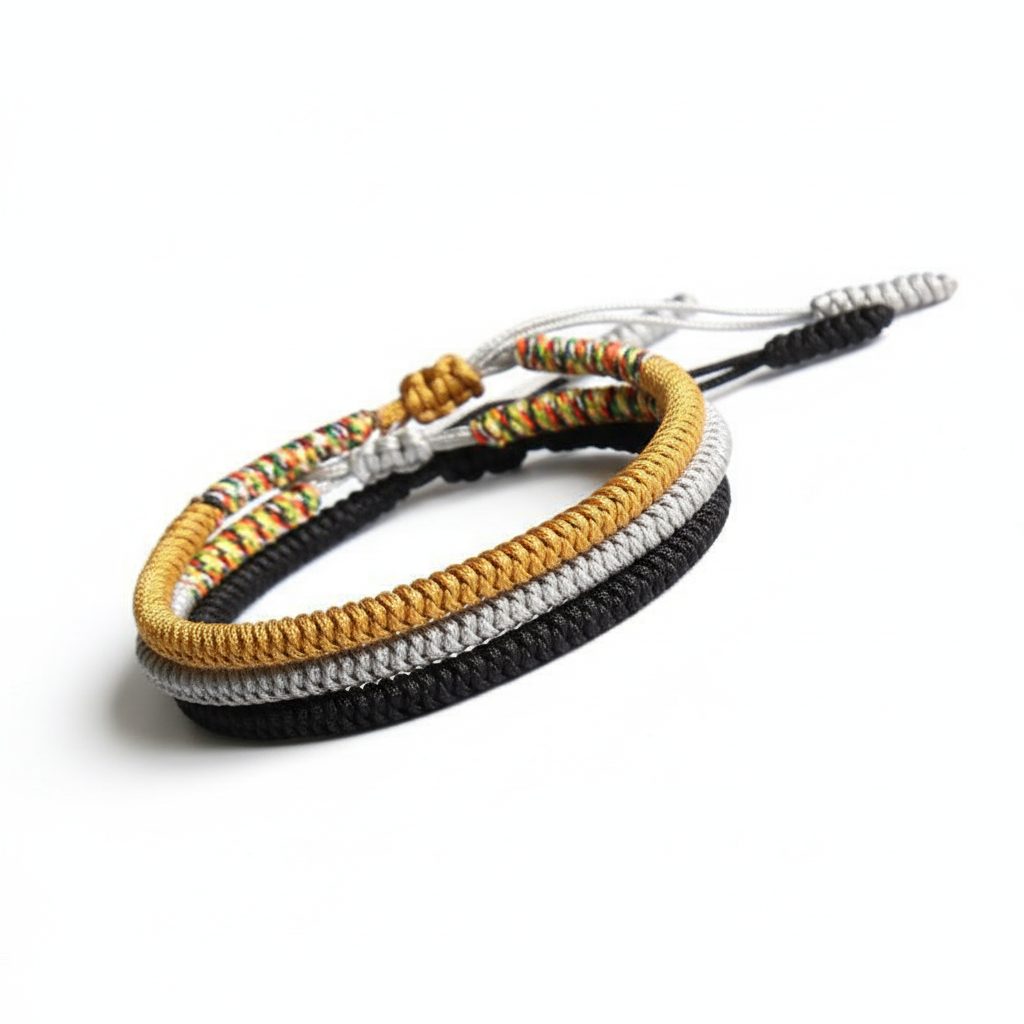
The Tibetan Lucky Knot Bracelet is handmade with traditional Tibetan braiding techniques and features the endless knot, traditionally linked to harmony and interconnectedness.
The Tibetan Handmade Lucky Knot Bracelet is hand-braided in soft rope with the endless knot, and comes in blue, gray and green, which makes it an easy first piece. The Tibetan Handmade Knot Bracelet and the Tibetan Knot Lucky Rope Bracelet are both handcrafted with a sliding closure.
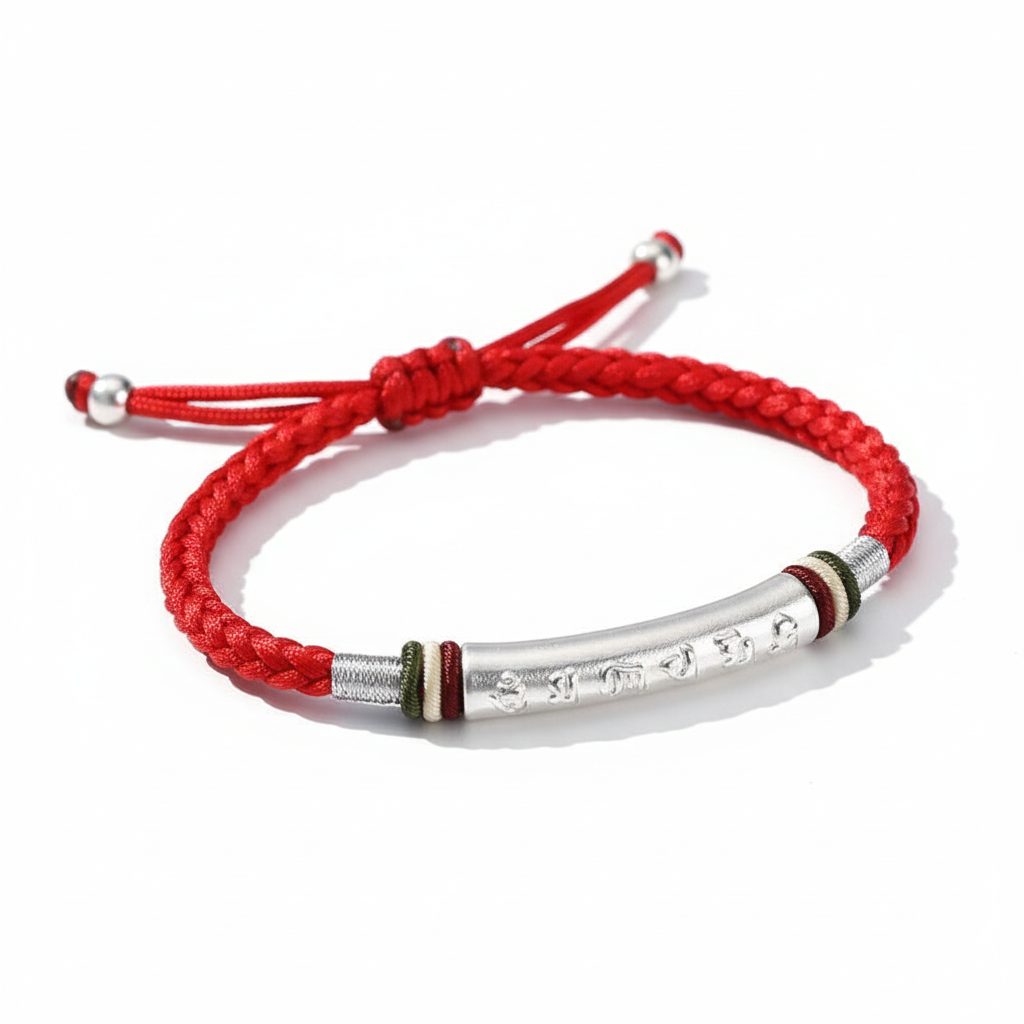
If you want the knot combined with a mantra, the Tibetan Braided Lucky Bracelet uses red braiding with metal alloy charms, the endless knot and the “Om Mani Padme Hum” mantra. To learn what those six syllables mean, read our guide to the Om Mani Padme Hum bracelet.
How to wear and adjust a sliding knot bracelet
- Loosen both ends by gently pulling the cord away from the knot until the loop opens.
- Slip it over your hand and place it where you like.
- Pull the two tails apart to close the loop until it sits snugly but does not press into the skin.
- Trim nothing. Leave the tails long enough that they cannot slip back through the knot.
Not sure about your size? Our guide to measuring your bracelet size shows how to do it in a minute. As for which wrist, the convention is the left to receive, and we explain the reasoning in which wrist to wear a red string bracelet.
Caring for a rope bracelet
- Water and sweat weaken rope over time. Take it off for showers and swimming.
- If it gets dirty, spot clean gently with a damp cloth and let it dry in the air.
- Do not tug on the knot pattern itself, since it holds the shape.
Tibetan, Chinese and Celtic knots compared
| Knot | Where it comes from | Common reading |
|---|---|---|
| Tibetan endless knot | Tibetan Buddhism (one of the Eight Auspicious Symbols) | Interdependence, wisdom and compassion |
| Chinese pán cháng knot | Chinese decorative knotting | Long life and unbroken good fortune |
| Celtic knot | Early medieval art of the British Isles | Eternity and interconnection, with varied readings |
What to look for when buying
- An even, tight braid with no loose loops around the knot pattern.
- A cord soft enough for the wrist but firm enough to hold its shape. Stiff, scratchy rope will rub.
- A sliding closure that moves smoothly and holds when you tug it gently.
- Honest descriptions: “handcrafted” or “hand-braided” should be backed by photos of the actual piece.
A matching gift for two
Because the endless knot stands for a bond with no beginning and no end, matching knot bracelets are a popular gift for couples, friends and family who live apart. Each person wears one, and the sliding closure means neither has to worry about getting the size exactly right.
Frequently asked questions
Is the Tibetan knot the same as the Celtic knot?
No. Both are endless-line designs, but they come from different cultures with different meanings.
Can I wear it every day?
Yes, if you are gentle with it. Rope wears faster than metal or stone, so replace it when it frays.
Is it appropriate to wear if I’m not Buddhist?
Many people wear it as a symbol of connection and good fortune. The respectful way is to understand what it stands for, and to avoid treating a sacred symbol as a throwaway accessory.
A note: symbol meanings here come from cultural and religious traditions and vary between sources. A bracelet is a personal reminder, not a guarantee of any outcome.
[social_share]