Black tourmaline and black obsidian look almost the same in a photo. Both are glossy, dark and popular for “protection” jewelry, and both get recommended in the same breath. They are not the same stone, though, and the differences matter when you are deciding which one to actually wear every day.
This guide compares them on the things that make a practical difference: what they are, how tough they are, how they look and feel, and what each is traditionally said to do.
The two stones side by side
| Black tourmaline | Black obsidian | |
|---|---|---|
| What it is | A crystalline mineral (the black variety is called schorl) | Volcanic glass with no crystal structure |
| Hardness (Mohs) | About 7 to 7.5 | About 5 to 5.5 |
| Everyday durability | Tough, resists scratching well | Scratches and chips more easily; it is glass |
| Look | Matte to satin, often with faint striations | Mirror-like gloss when polished |
| Traditional association | Grounding and shielding | Protection and honest self-reflection |
What black tourmaline actually is
Tourmaline is a family of boron silicate minerals, and the black kind is the most common. It forms real crystals, usually long and striated, which is why polished beads often show faint lines. It is a hard stone, harder than obsidian, so it holds up well to daily wear.
Tourmaline also has a genuine and unusual physical property: it can build up a static charge when heated or pressed. Dutch traders in the early 1700s reportedly used it to draw ash out of their pipes, and some of tourmaline’s reputation as an “energy” stone traces back to that. Whatever you believe about crystal energy, the physical fact is a nice story, and it explains why tourmaline is so tied to the idea of shielding.
What black obsidian actually is
Obsidian forms when silica-rich lava cools too quickly for crystals to grow, leaving natural volcanic glass. That is why it can be polished to a mirror shine, and also why it behaves like glass: it can chip if knocked hard, and a deep scratch does not buff out easily. Ancient people used it for blades and polished mirrors for exactly this reason, and it has been treated as a stone of clear sight and protection for a very long time.
If you want to know more about how it is used in jewelry, read what an obsidian bracelet does, and how to cleanse black obsidian jewelry if you already own some.
Which should you choose?
Choose black tourmaline if…
- You want a piece for everyday wear that will keep its finish.
- You are drawn to the idea of grounding, a steady “anchor” for a busy day.
- You prefer a softer, less reflective look.
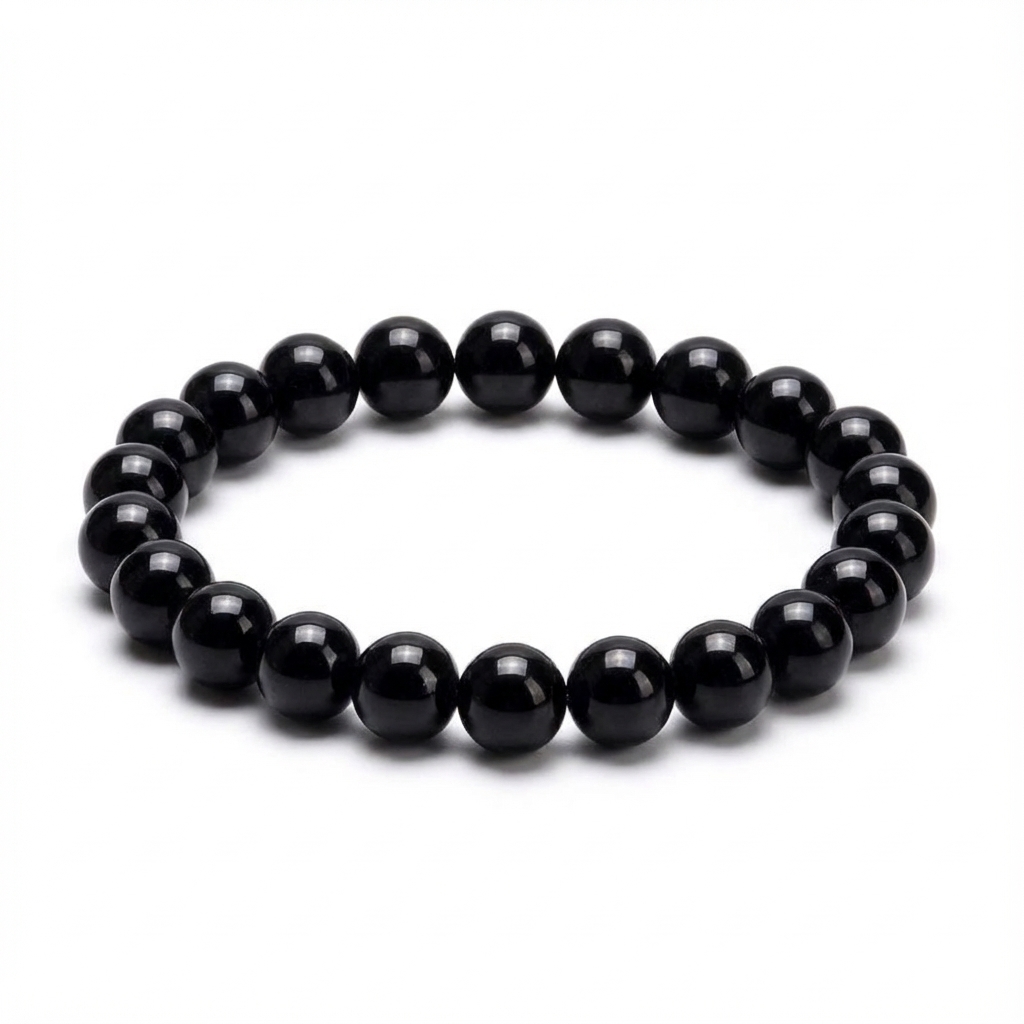
The Natural Black Tourmaline Bracelet uses 8mm genuine black tourmaline beads on a 6.5-inch bracelet made to fit most wrists. It is the simplest way to try tourmaline. If you like a pendant more than a bracelet, the Black Tourmaline Metatron Cube Necklace combines black tourmaline with seven colorful chakra stones and the Metatron’s Cube symbol.
Choose black obsidian if…
- You love a glossy, dark, mirror-like finish.
- The idea of honest self-reflection appeals to you more than “shielding”.
- You will treat it a little more carefully, taking it off for heavy work or sport.
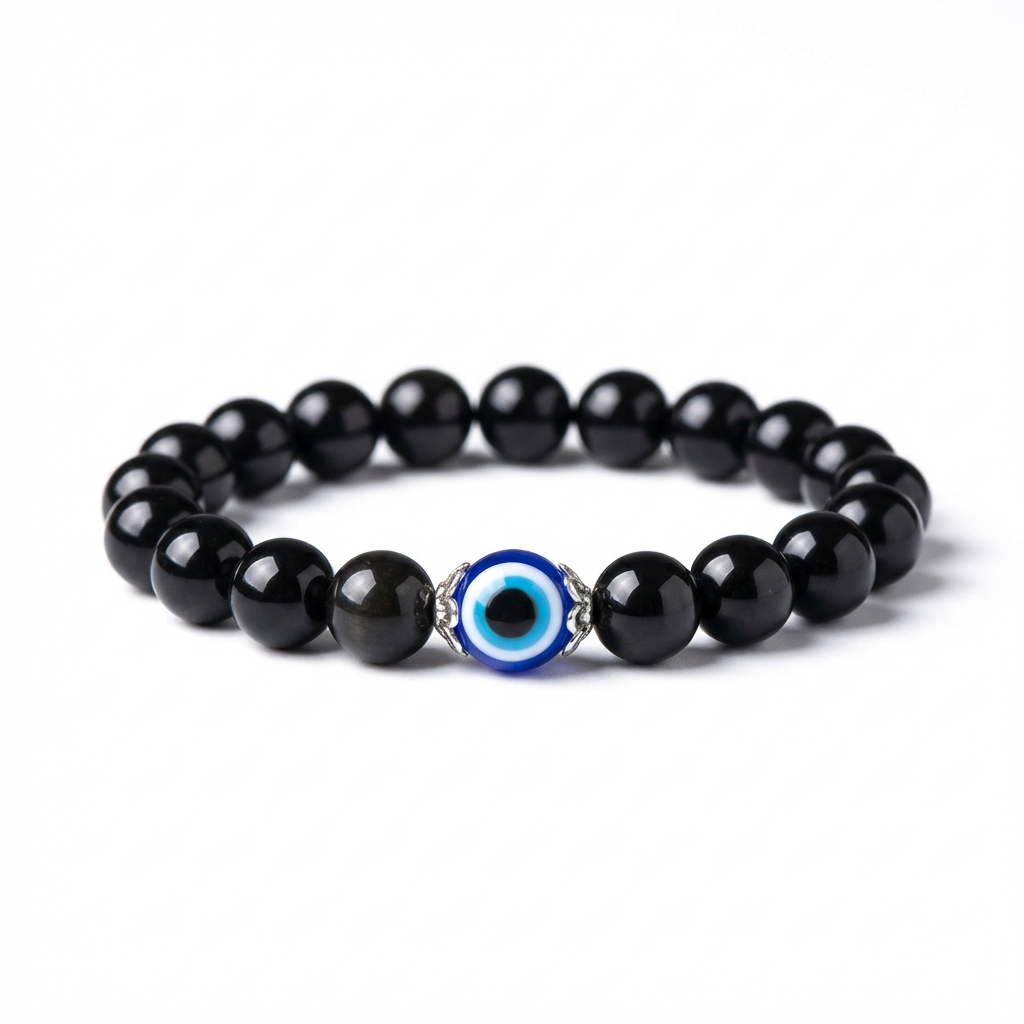
The Black Obsidian Evil Eye Protection Bracelet pairs polished 8mm natural black obsidian beads with a 10mm resin Evil Eye charm on an elastic cord. Obsidian is also central to our Pixiu pieces, such as the Black Obsidian Pixiu Bracelet, if you want the wealth theme as well.
Can you wear both?
Yes, and many people do. A common way to do it is one on each wrist, or stacked together on one wrist. The two stones are traditionally seen as complementary: tourmaline for steadiness, obsidian for clarity. If you want to see how other stones fit with them, our feng shui crystal bracelet guide covers the common pairings.
How to tell real from fake
Because both stones are dark and plain, imitations are common. Some quick checks:
- Real obsidian is glass, so it should feel cool and a little heavy, and may show tiny natural flow lines. Perfectly uniform “obsidian” with visible bubbles is likely factory glass.
- Real tourmaline often shows faint parallel striations and a slightly satin surface. A flawless, perfectly glossy black bead may be dyed or a different material.
- Ask the seller. A reputable jeweler will tell you the bead size and the stone. Both bracelets above list their materials and bead size in the product details.
How they compare with onyx and hematite
Two other dark stones get mixed up with these two constantly, and it helps to know how they differ.
- Black onyx is a banded form of chalcedony, a type of quartz, with a hardness around 6.5 to 7. Much of the black onyx on the market is agate that has been dyed a uniform black, so ask whether the color is natural.
- Hematite is an iron oxide with a silvery, metallic shine, and it feels noticeably heavy for its size. “Magnetic hematite” beads are often man-made, and the material is more brittle than tourmaline.
- Black tourmaline and obsidian are the two usually sold as protection stones, and neither has a metallic shine.
Bead size and fit: what looks right on the wrist
Bead size changes how a bracelet looks more than most people expect. 8mm, the size used in both bracelets above, is a common middle ground: substantial enough to read as a stone bracelet, small enough to slip under a shirt cuff. Smaller beads look delicate and suit slim wrists, while larger ones make a bolder statement. If you are between sizes, our guide to measuring your bracelet size takes about a minute and saves a return.
Frequently asked questions
Which is stronger for protection?
Traditions do not rank them. Tourmaline is associated with grounding and shielding, obsidian with protection and honesty. Choose the one whose story and look you connect with.
Is black tourmaline better for daily wear?
Physically, yes. It is harder and more resistant to scratches and chips than obsidian.
Do they need cleansing?
Many people cleanse both stones regularly. Our guide to cleansing crystals lists the methods that are safe for each.
A note: crystal properties come from tradition and personal belief, and there is no scientific evidence that stones protect you. Treat them as meaningful jewelry, not as a substitute for practical safety or professional advice.
[social_share]